

If you’ve looked in the mirror at the end of summer and thought “Why does my pigmentation suddenly look worse?”, you’re not imagining it.
Every year around March and April we start seeing the same pattern at VC Dermal in Berwick. Clients come in saying their skin looked relatively even during summer, but now the sun has eased off, the pigmentation seems darker and more noticeable.
There’s a very real reason this happens, and understanding it can help you treat it properly.
The Hidden Effect of Summer Sun on Your Skin
During summer your skin is constantly exposed to UV radiation. Even if you’re wearing SPF (which you absolutely should), some UV exposure still occurs.
When UV hits the skin it triggers cells called melanocytes to produce melanin, the pigment that gives skin its colour.
This is your skin’s natural protection mechanism.
The problem is that when the skin has already experienced inflammation or damage in the past – from:
- previous sun exposure
- acne
- hormonal changes
- heat
- irritation
…the melanocytes can become overactive.
Instead of producing pigment evenly, they start producing it in patches or clusters.
This is what we see as:
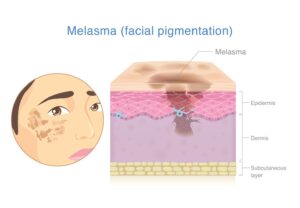
- melasma
- sun spots
- post-inflammatory pigmentation
- uneven skin tone
Why Pigmentation Often Looks Worse After Summer
Many people expect pigmentation to look darker during summer, but the opposite often happens.
During summer:
- the surrounding skin becomes more tanned
- pigmentation blends in more with the rest of the skin
- increased oil production can give the skin a temporary glow
Once autumn arrives:
- the tan begins to fade
- the surrounding skin lightens
- the darker pigment underneath becomes more visible
So the pigmentation was developing during summer, but you’re noticing it more once the tan fades.
Heat and Inflammation Also Play a Role
It’s not just UV that affects pigmentation.
Heat itself can stimulate pigment production.
This is why we often see worsening pigmentation in people who spend time:
- outdoors in summer heat / at the beach
- exercising outside
- in saunas or hot environments
Heat increases inflammation in the skin, which can trigger melanocytes to produce more pigment.
For clients prone to melasma, this is particularly important.
The Biggest Mistake People Make With Pigmentation
One of the most common things we see is people trying to treat pigmentation during the middle of summer.
In reality, this is when treatments are often least effective.
When the skin is exposed to ongoing UV and heat, the pigment process is still active. Trying to remove pigment while the skin is still producing it can become frustrating.
This is why autumn and winter are usually the best time to begin treating pigmentation properly.
The skin is more stable, sun exposure is lower, and treatments can work far more effectively.
What Actually Works for Treating Pigmentation
Pigmentation treatment isn’t usually about one treatment or one product.
It’s about a strategy.
At VC Dermal in Berwick we usually approach pigmentation in three stages:
1. Stabilise the Skin
Before we aggressively treat pigment, we calm inflammation and strengthen the skin barrier.
This often involves targeted skincare ingredients that regulate melanocyte activity.
2. Break Down Existing Pigment
Once the skin is stable, we introduce treatments designed to gradually break down pigment within the skin.
Depending on the type of pigmentation, this may involve:
- clinical peels
- laser treatments
- skin needling
- targeted active ingredients
3. Prevent Pigment Returning
This is the stage many people overlook.
Without prevention, pigmentation almost always comes back.
Long-term management usually involves:
- proper SPF use
- pigment-regulating skincare (melanin inhibitors)
- maintenance treatments when required
Every Pigmentation Case Is Different
Pigmentation isn’t one single condition.
What looks similar in the mirror can actually be very different biologically.
For example:
- melasma behaves very differently to sun damage
- post-acne pigmentation requires a different approach again
Treating pigmentation correctly starts with understanding what type it is and why it developed in the first place.
If You’re Noticing More Pigmentation After Summer
If your pigmentation looks more noticeable now that summer is ending, it may actually be the perfect time to address it.
At VC Dermal in Berwick, we begin by analysing the skin and understanding:
- what type of pigmentation is present
- what triggered it
- what the most effective treatment pathway will be
From there we create a personalised treatment and skincare plan designed to improve the skin safely and gradually.
Because when pigmentation is treated correctly, the results can be incredibly rewarding.
If you’d like help understanding your skin or want to explore treatment options, our team at VC Dermal Berwick are always happy to guide you through the process.
Yours in Beauty,
Victoria xx
